

Call Report Treatment of BOLI
Many of our current clients have questions regarding how to enter BOLI accounting information on their call reports and TFRs. Below is guidance on how to record BOLI transactions.
Quick Reference for Call Report Treatment of BOLI
| Schedule RI – Income Statement | |
| Schedule RI , Item 5.l, “Other noninterest income” | Include the net change in the cash surrender value of BOLI policies. |
| Schedule RI-E, Item 1.b, “Earnings on/increase in value of cash surrender value of life insurance” | Include the net change in the cash surrender value of BOLI policies if such amount is greater than 1% of the sum of total interest income and total noninterest income. |
| Schedule RI , Item 7.d, “Other noninterest expense” | Include the BOLI expenses for policies in which the institution is the beneficiary |
| Schedule RI-E, Item 2.h, “Other noninterest expense” | Include the BOLI expenses for policies in which the institution is the beneficiary if such amount is greater than 1% of the sum of total interest income and total noninterest income. |
| Schedule RC – Balance Sheet | |
| Schedule RC, Item 11, “Other assets,” and Schedule RC-F, Item 5, “All other assets” | Include the amount that could be realized under BOLI policies as of the report date. |
| Schedule RC-F, Item 5.a, “General account life insurance assets” | Amount realized under general account BOLI policies as of the report date. |
| Schedule RC-F, Item 5.b, “Separate account life insurance assets” | Amount realized under separate account BOLI policies as of the report date. |
| Schedule RC-F, Item 5.c, “Hybrid account life insurance assets” | Amount realized under hybrid account BOLI policies as of the report date. |
| Schedule RC-R – Regulatory Capital Report | |
| Schedule RC-R Part II, item 8 – All other assets | General Account Policies – Column I |
| Separate Account and Hybrid Account Policies – Column R and Column S | |
Entering BOLI on Schedule RI – Income Statement
The change in cash surrender value is reported on Schedule RI in item 5 (Noninterest income), line l – “Other noninterest income.” On the TFR, BOLI is entered in SO488, “Other Noninterest Income”. The amount to enter is the net change in the cash surrender value of BOLI policies.
The monthly report provided by EBN gives a carrier-by-carrier and policy-by-policy summary of each individual life insurance policy owned by the bank. This report assists the bank with monthly general ledger entries for these subsidiary accounts. These subsidiary accounts will allow the bank to record net policy earnings on a policy and carrier specific basis. However, for the purposes of making these entries on the call report, enter the entire net change in cash surrender value for all policies for all carriers.
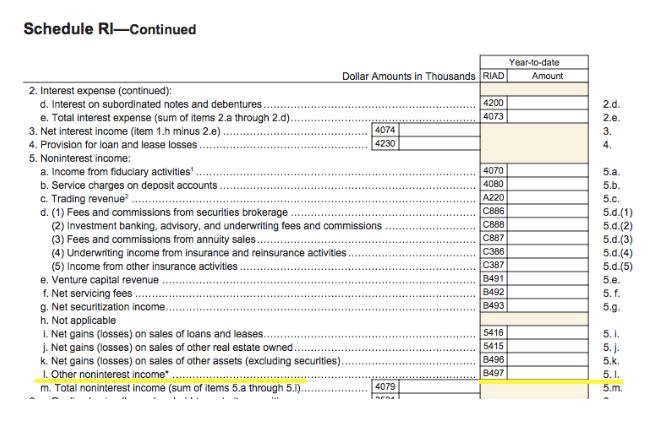
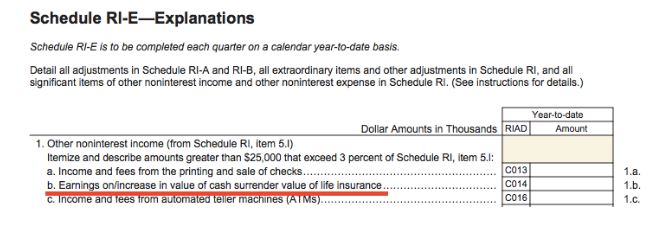
Additionally, these other non-interest income will be detailed on Schedule RI-E, Item 1.b, “Earnings on/increase in value of cash surrender value of life insurance.”
For the Call Report, include the net change in the cash surrender value of BOLI policies if such amount is greater than 1% of the sum of total interest income and total non-interest income. For the TFR, include on SO492, 496, or 498 if the amount is one of the two largest items comprising the amount reported in SO488.
The next two entries must be made on the bank’s Call Reports only if the institution reports the gross earnings (losses) on or increases (decreases) in the cash surrender value in Call Report Schedule RI, Item 5.l. On the EBN monthly report, we generally do not report gross earnings and instead provide net (of expenses and mortality charges) to the bank. Most of our clients find that this provides a clear picture of what the income is to the bank each month.
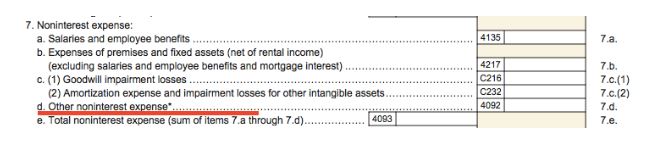
However, if the bank reports the gross earnings or losses on BOLI, then entries must be made for those expenses on Schedule RI , Item 7.d, “Other noninterest expense”. For the Call Report, include the BOLI expenses for policies in which the institution is the beneficiary.
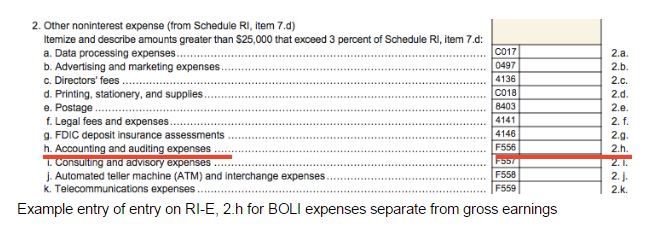
If gross BOLI earnings are recorded, a separate entry must also be made on Schedule RI-E, Item 2.h, “Other noninterest expense.” In general, most BOLI vendors, including EBN, provide the net BOLI earnings on the monthly account values report for the financial institution. This is the amount that could be realized after any and all expenses, mortality charges and surrender charges have been deducted for each of the BOLI policies. If gross earnings are only reported and other expenses are included as a separate line item on the BOLI report then a separate entry needs to be made on the Call Report on RI-E, 2.h that include the BOLI expenses for policies in which the institution is the beneficiary only if such amount is greater than 1% of the sum of total interest income and the total noninterest income.
Entering BOLI on Schedule RC – Balance Sheet
After completing entries on the income statement, BOLI earnings entries can now be entered on the bank’s balance sheet. First, the cash surrender value of the BOLI policies on the bank’s Consolidated Report of Financial Income and Condition (“Call Reports”) on Schedule RC, line 11.
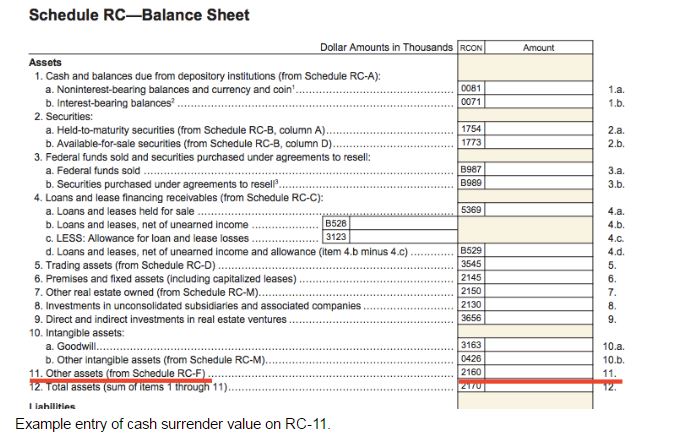
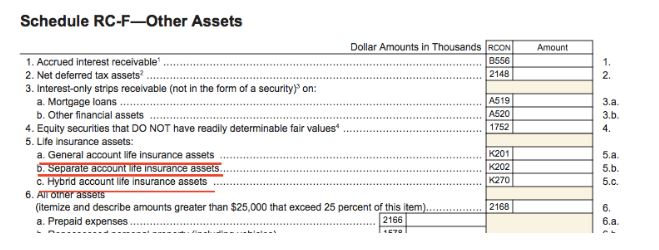
BOLI cash surrender is further detailed on RC-F on Line 5. Beginning in 2006, a bank that owned BOLI is required to specify the type of BOLI that it owns – separate account, general account or hybrid. EBN provides a designation for the specific types of BOLI policies on the monthly reports we send to clients. Item 5 is further separated into 3 types of life insurance:
- 5.a is for general account life insurance assets
- 5.b is for separate account life insurance assets
- 5.c is for hybrid account life insurance assets
Entering BOLI on the RC-R – Regulatory Capital Report
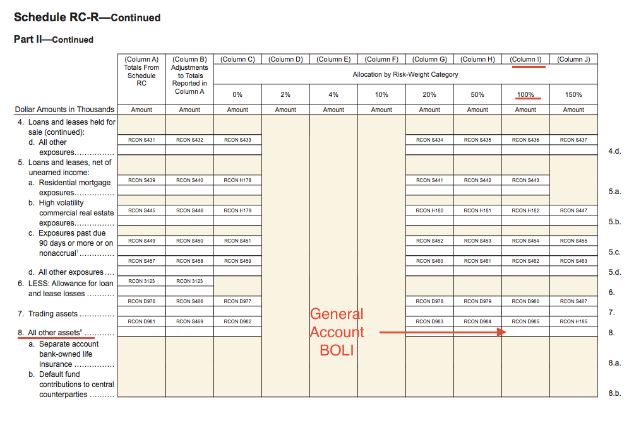
BOLI cash surrender value is entered on Schedule RC-R Part II, item 8 – All other assets.
General account policies are risk weighted at 100% and are entered in Column I. General Account BOLI assumes the general assets of the insurance company issuing the BOLI policy will support the policy’s cash values. In addition the credit risk of the portfolio are guaranteed by the carrier and typically a minimum interest crediting rate is provided. General Account BOLI is and will continue to be recognized at a risk weighting at 100%.
Separate account and hybrid account bank owned life insurance products are reported in 8.a in columns R and S. The cash surrender value is reported in column R and the risk-weighted asset amount is reported in column S. Depending on the specific policy, separate account and hybrid account policies are risked weighted based on the underlying investments of the policy. Risk weights range from 100% to 20%.
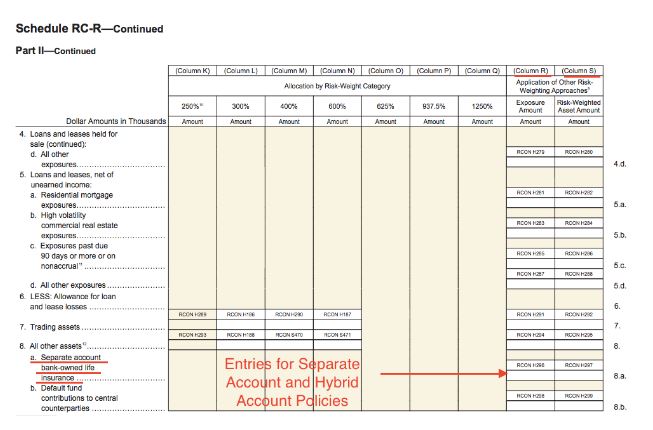
The FDIC recognizes 3 different methods to determine the risk weighting of separate account (and now hybrid account policies). These are:
- Full Look-Through Approach: The aggregate risk-weighted asset amounts for all investments held by the fund are multiplied by the banking organizations’ proportional interest in the fund.
- Simple Modified Look-Through Approach: A banking organization multiplies its exposure to the fund by the highest risk weight of any of the assets in the fund.
- Alternative Modified Look-Through Approach: Calculate risk-weighted asset amount based on pro-rata basis based on permitted maximum allocation by sector. Risk-weighting over 100% is possible.