

The Three Types of Bank Owned Life Insurance (“BOLI”)
There are a multitude of Bank Owned Life Insurance policies available to financial institutions today. Based on the most recent data available, the majority of banks in the United States list BOLI as an “Other Asset” on Schedule RC-F on their call report.
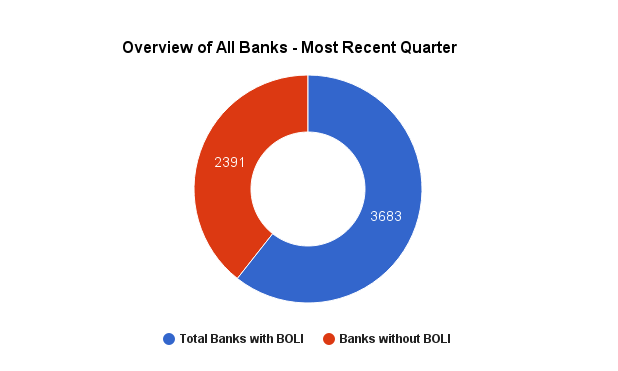
In general, the type of BOLI policy a bank purchases can be divided into three separate categories:
- General Account BOLI – the premium amounts are directly invested in the general account of the life insurance company.
- Separate Account BOLI – the assets are placed in accounts that are separate from the carrier’s general account and invested in accounts at the financial institution’s direction (generally in bank eligible investments).
- Hybrid Account BOLI – these type of policies combine both General Account and Separate Account features based on the specific type of policy purchased.
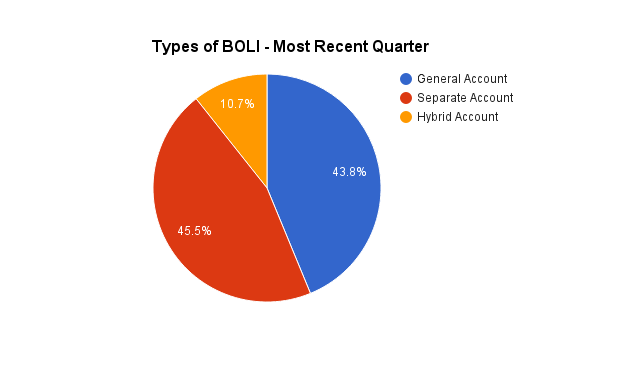
Banks are now required to categorize the type and amount of BOLI on their call report. Based on the most recent data, the percentage of each BOLI type is represented below.
Overview of General Account BOLI
General Account BOLI products are by far one of the the most popular options in the marketplace today and have been around for more than 50 years. Assets in a general account product are invested at the direction of the insurance carrier.
Performance and Yield
This BOLI structure provides attractive guaranteed minimum interest rates and desirable preservation of principal against investment losses whereas the ultimate risk with variable separate account BOLI is a complete loss of principal. The associated policyholder returns are based on either the underlying rate of the overall portfolio or a new money rate tied to the time the policy was purchased. According to a recent study ended June 30, 2014, 6/30/14, general account BOLI outpaced separate and hybrid account BOLI in terms of net interest returns with general accounts providing a 3.10% return, separate accounts a 2.67% return and hybrid accounts providing a 2.87% return.
Investment Options
The “hidden” benefit to General Account BOLI products are that they provide exposure to the bank investment options that they would not be permitted to directly invest in. These include diversified pools of asset classes like private equity, mezzanine, real estate and direct commercial mortgages.
Risk
Interest rate risk is related to the general account of the insurance carrier and could affect returns. Under Basel III rules, General Account BOLI products are considered “Corporate Exposures” and will continue to be risk-weighted at 100%. The underlying assets of the in the policy are also subject to the general creditors of the life insurance company.
General Account BOLI, as a whole, is simple to understand and evaluate from an investment and for a financial institution.
Overview of Separate Account BOLI
Separate Account BOLI is a more recent addition to the options available to financial institutions. Assets in a separate account BOLI product are invested at the direction of the bank into bank-eligible classes with the insurance carrier.
Performance and Yield
Return on the underlying cash surrender value is determined by the performance of the investment. Separate Account BOLI does not provide a guaranteed minimum interest crediting rate and are more complex than other options. Because there is no minimum rate, some carriers provide a stable value wrap that attempts to smooth the returns of the policy. In addition, most Separate Account products have a surrender charge associated with each policy.
Investment Options
The premium must be invested into bank eligible assets. Fees and returns are transparent and reported to the financial institution monthly.
Risk
Interest rate risk is directly related to the underlying performance of the investment account Risk weighting of Separate Account BOLI requires a look through approach. Under Basel III rules, there are three methods to risk-weight Separate Account BOLI. Depending on the approach and the underlying asset, Separate Account BOLI policies can be risk weighted as high as 1,200%. The underlying assets in the separate account are separate from the general creditors of the life insurance company.
Overview of Hybrid Account BOLI
Hybrid Account BOLI is a combination of General Account and Separate Account BOLI products. It was introduced as a way to reduce the risk weighting of the policy while also seeking to see the upside of a separate account. In reality, it never has really achieved either goal. New regulations effective in 2015 require that all hybrid accounts be risk-weighted at 100%. Further, returns inside Hybrid Account BOLI policies have not produced the returns promised.