
Notice and Consent Requirement for BOLI
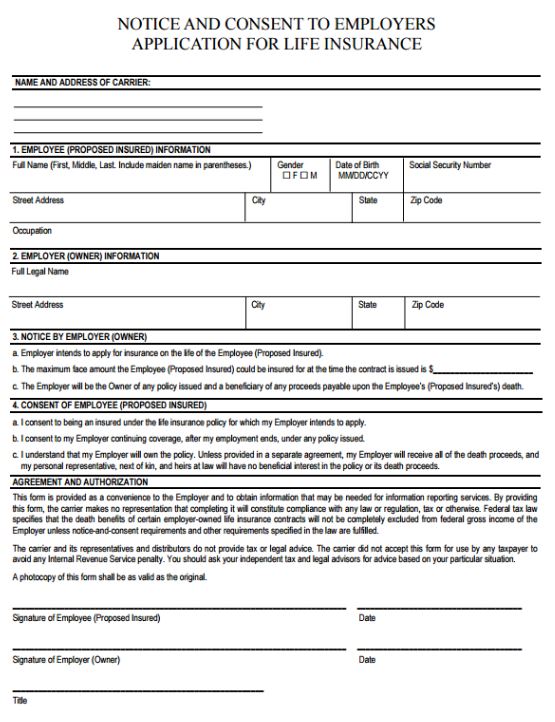
One of the most common questions we get from current and prospective clients is what are their duties regarding notifying employees when a BOLI policy is contemplated. Not only is it a best practice do both notify and obtain consent from employees who will be covered by a BOLI policy, it is also required by law to do so. The Notice and Consent requirement outlined below are required to be put into place before a bank purchases or implements a 1035 tax-free exchange of BOLI. Failure to comply with these requirements will result in adverse tax consequences – including taxation of the death benefit to the bank.
Overview of the Notice and Consent Requirements
Generally, the death benefits payable under a life insurance contract are tax-free
under the exclusion rule in Section 101(a). This exception does not apply for business owned or bank owned life insurance under Section 101(j). Internal Revenue Code Sec. 101(j) is the first step in determining the eligibility and the notice and consent requirements applicable to a BOLI purchase or 1035 tax-free Exchange.
The basic rule is that any death benefits received from BOLI by the bank are taxable as ordinary income unless one of the following four exceptions apply:
- The insured is a director or a highly compensated employee;
- The insured was employed by the bank no later than 12 months prior to death;
- The benefits received from the BOLI on the insured’s death are payable to the employee’s beneficiaries and/or heirs (ie, family member, trust or estate of the employee);
- The death benefits are used to purchase an interest in the business.
The most common exception to the 101(j) rule is the “key person” exception noted in #1 above. Interestingly, the key person exception is the only prospective safe harbor available to a bank. All of the other exceptions apply retrospectively – the bank will not know if #2 – #4 apply until after the employee’s death.
An employee can be classified as a highly compensated employee if one of the following apply:
- The employee has compensation in excess of the 414(q) limit ($120,000 for 2016);
- The employee was in the top 35 percent of all employees under 105(h);
- The employee owns 5% or more of the business or bank.
Annual Reporting Requirement
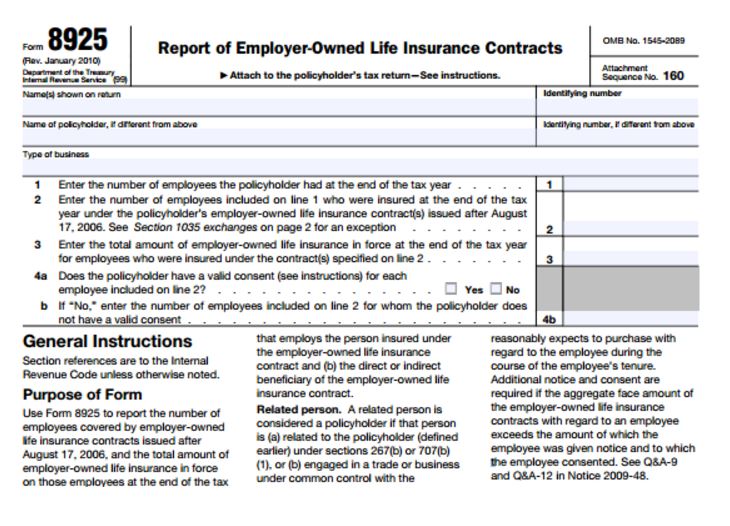
In addition to the eligibility and written notice and consent forms outlined above, the bank must also complete Form 8925 on an annual basis to avoid taxation of the death benefits. EBN assists with completing Form 8925 for all of it’s current bank clients on an annual basis.
Section 6039I requires that a return by a bank through Form 8925 be filed by “every applicable policyholder owning 1 or more employer-owned life insurance contracts issued after the date of enactment.”
Form 8925 is included with the bank’s tax returns and is used to report:
- The number of employees covered by bank-owned life insurance contracts issued after August 17, 2006;
- The total amount of bank-owned life insurance in force on those employees at the end of the tax year;
- The name, address and taxpayer identification number of the company, and the type of business in which the company is engaged; and
- That the company has a valid consent for each insured employee (or, if all required consents are not obtained, the number of insured employees for whom consent was not obtained).
A sample of Form 8925 is detailed below.
Common Questions Relating to Notice and Consent Requirements
When is a policy “issued” for purposes of determining whether the notice and consent are timely, or whether the insured is a director, a highly compensated employee, or a highly compensated individual at the time the contract is issued?
According to Q-4 of Internal Revenue Bulletin 2009-24, “the issue date of a contract is the date on the policy assigned by the insurance company, which is on or after the date the application was signed” and that “an employer-owned life insurance contract is treated as “issued” on the later of (1) the date of application for coverage, (2) the effective date of coverage, or (3) the formal issuance of the contract.”
The notice goes on to state that satisfying the notice and consent requirements during the underwriting process is an acceptable practice. From a practical standpoint, this is generally an appropriate time to obtain written notice and consent for a BOLI purchase because the face amount of insurance cannot be quantified until underwriting is completed but before the formal issuance of the contract.
How long is a written notice and consent good for? Do they expire?
A valid written and consent is good for the earlier of (1) 1 year after the effective date of the consent or (2) termination of the employee’s employment. For example, if a potential insured terminates from employment within 1 year after signing the notice and consent and the policy has not been issued, then the notice and consent is deemed to be invalid.
If a bank contemplates purchasing multiple policies on an individual employee, do they need separate written notice and consent forms for each policy?
According to Q-10 of Internal Revenue Bulletin 2009-24, the bank does not need separate notice and consents if applying for more than one policy on the employee so long as the amount listed on the notice and consent form exceeds the total of all policies on the insured. However, EBN generally finds that it is better to obtain separate notice and consent forms for each carrier. This ensures that the potential insured is well informed and provides an additional level of protection for the bank.
What happens if a BOLI is exchanged under Section 1035? Are new notice and consent forms required to complete the exchange?
No additional notice and consent is required unless the total face amount under the new policy exceeds the amount consented to for the prior policy and the existing consent remains valid (ie, within 1 year and the employee is still employed by the bank) or the exchange does not result in a material change in the death benefit or other material change in the contract.
An eligibility determination to obtain the safe harbor provisions of 101(j) to receive the death benefit tax-free and complying with all of the notice and consent requirements outlined above are crucial for both an initial and ongoing management solution for the bank. Failure to comply could result in adverse tax consequences to the bank. Let a trusted advisor at EBN help with the process.